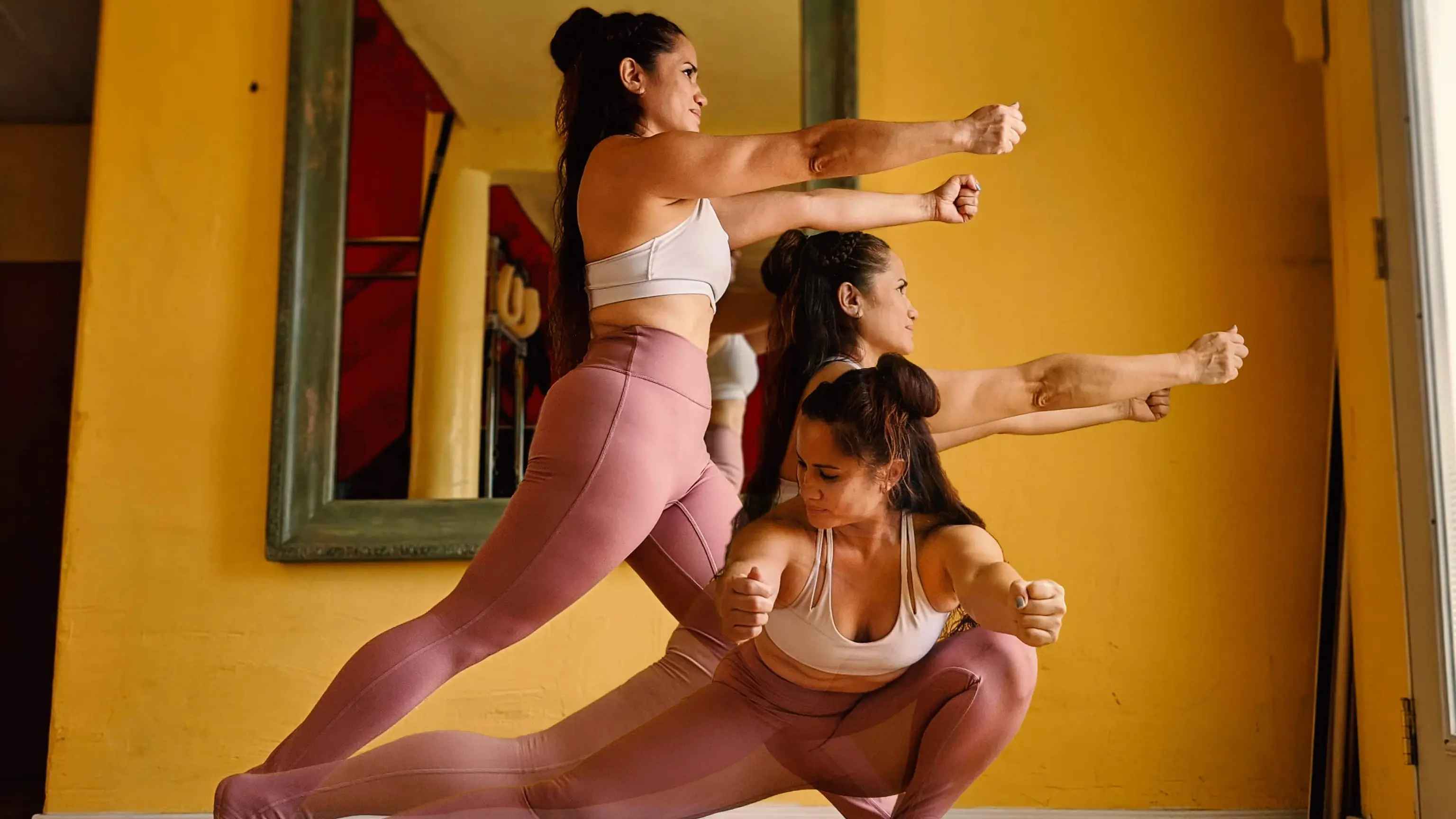
Unlock Your Flexibility with This Mobility Training Method
by Khayla Jordan Golucke • 5:30 mins read
If you’ve ever struggled to find a deeper plié, more turn out, or higher développés, you may have implemented more stretching into your dance training regimen. Conversely, for those dancers who are naturally bendy, you may have heard you need to start strength training so that you don’t injure yourself. Wherever a dancer falls on the flexibility spectrum, the missing key to unlocking more range of motion without injury could be something else entirely: mobility training.
Functional Range Conditioning (FRC) and Kinstretch (a class incorporating the principles of FRC) focus on science-based mobility and joint-training techniques to improve strength at the end range of motion: think, being able to control your leg when it’s at its highest point in a développé and all the way back down. According to Kimberly Spencer, a former professional ballerina turned Pilates, dance, and certified Kinstretch instructor who works with the dance programs at Cal State Long Beach and Los Angeles County High School for the Arts, doing FRC or a Kinstretch class is like “if you can imagine stretching and strengthening at the same time.”
With its focus on not just improving movement at a joint but also controlling it to reduce injury, the FRC system is already finding success in professional sports environments, where athletes often perform repetitive movement in more extreme ranges of motion. Dancers put demands on their bodies in very similar ways, making the mobility training method a natural fit for the dance sector as well. As the method can help dancers at virtually any level, it could be easily incorporated into dancers’ group cross training classes and even dance warm-up routines, possibly unlocking a new, safe and effective way to improve dance technique and flexibility.
How does Functional Range Conditioning work?
The FRC system “works by systematically expanding the body’s ranges of motion, while simultaneously teaching the nervous system how to control the newly acquired ranges,” according to the method’s website. Developed by chiropractor Dr. Andreo Spina, it relies on specific techniques to help you gain strength and control in new ranges of motion, including Controlled Articular Rotations (CARS) and Progressive and Regressive Angular Isometric Loading (PAILS and RAILS). Without getting too deep into the science that the method is based on, the main idea is that progressively training the muscular control of joints in their long and short ranges will help the joint tissues handle load at greater ranges of motion, leaving them less likely to be injured. Much like ballet, FRC is technically detailed and should be practiced with proper alignment, but unlike dancing or sitting in a stretch, it utilizes isometrics and tension to help convince your brain that you can go further in the range of motion at a specific joint.
Why is Functional Range Conditioning specifically good for dancers?
The idea of passive stretching (i.e. sitting in your splits for over two minutes) being the only way to gain the flexibility needed for dance has come into question by dance science research of late, notably in The Australian Ballet’s study that discovered how de-emphasizing calf stretching and adding in calf strengthening exercises at barre significantly decreased calf injuries in their dancers. Sue Mayes, head physiotherapist at the company, described to Dance Informa that they shifted their mindset from focusing on stretching to “optimising your capacity, strength and power at those end ranges. We have found that by strengthening, you can increase your range of movement much more effectively and safely obviously.”
The principles of Functional Range Conditioning lend themselves to the findings from The Australian Ballet’s research in considering a mobility training routine for dancers that will help prevent injury. “The system helps identify specific joint weaknesses with self-assessing tools that can be used forever to help a dancer stay on top of impending problems for both practice and performance days,” Kimberly Spencer says, “I think it's especially beneficial for athletes and dancers who need to balance repetitive movements and also need to have the strength and control within each joint to tolerate the forces and impacts of their sport or dancing. If work isn't being done to increase ranges for better hip rotation or extension, deeper and more powerful pliés, then there's maintenance work (through FRC) that can prevent, or prevent the severity of, injuries.”
FRC could be more than a new cross training trend for dancers, but a staple in dance training programs
Spencer has used the FRC method with dancers in high school and college who are unaware of just how little they have control over their body or flexibility during dynamic movement. For example, a dancer may be able to do the splits with complete ease, but may also struggle to hold a développé with proper positioning or find much power and length in their legs in a split leap or grande jeté. FRC can help these dancers to gain more control and strength in the range of motion of their hip joints so they can do these technical skills. On the other end of the spectrum, a dancer who’s having trouble developing the flexibility needed for a higher développé or split leap can use FRC to gain more range of motion in their hip joints to facilitate the movement. “The same system that can help one dancer increase more ranges and therefore provide more freedom of movement, can help the super flexible dancer be stronger and dance with the same freedom safely and for longer,” Spencer says.
Where can dancers go to find classes incorporating Functional Range Conditioning?
You can find Functional Range Conditioning techniques and principles incorporated into many different types of cross training classes, often in those that focus on mobility, such as Dr. David Odom’s dance warm up and mobility videos on DancePlug. If you want to try a full FRC or Kinstretch class, you can find a list of certified providers near you on the FRC website or check out Kimberly Spencer’s dancer-specific programs.
With its many scientifically-proven benefits and ability to lessen injuries in athletes, FRC could be more than a new cross training trend for dancers, but a staple in dance training programs to help dancers increase their flexibility and technical skills while preventing injury. As dancers are expected to perform in extreme ranges of motion more now than ever, new methods like Functional Range Conditioning could be key to unlocking dancer flexibility, helping dancers have longer performance careers, and to avoiding long-term pain as they get older.
Other Articles

Holiday Travel Got You Feeling Stiff? Here’s What You Can Do!
Caitlin M HeflinTis the dance season of traveling for work. Set yourself for physical and mental success with these expert tips.
Dancing with an Aging Body: How to Approach the Mental Hurdles
Kathryn BolandWhether you consider yourself "young", "old", or anywhere in between, aging is inevitable. What does this mean for the professional dancer?

A native of El Paso, TX, Khayla began dancing at a young age in ballet and Folklorico classes, eventually moving to LA to earn her BA in dance and English from Loyola Marymount University in Los Angeles. She went on to earn her MA in Arts & Cultural Management from Kings College London before moving back to LA, where she currently works as a commercial dancer. When she's not dancing, you can find her teaching Pilates and freelance writing about the intersection of dance, fitness, and wellness.