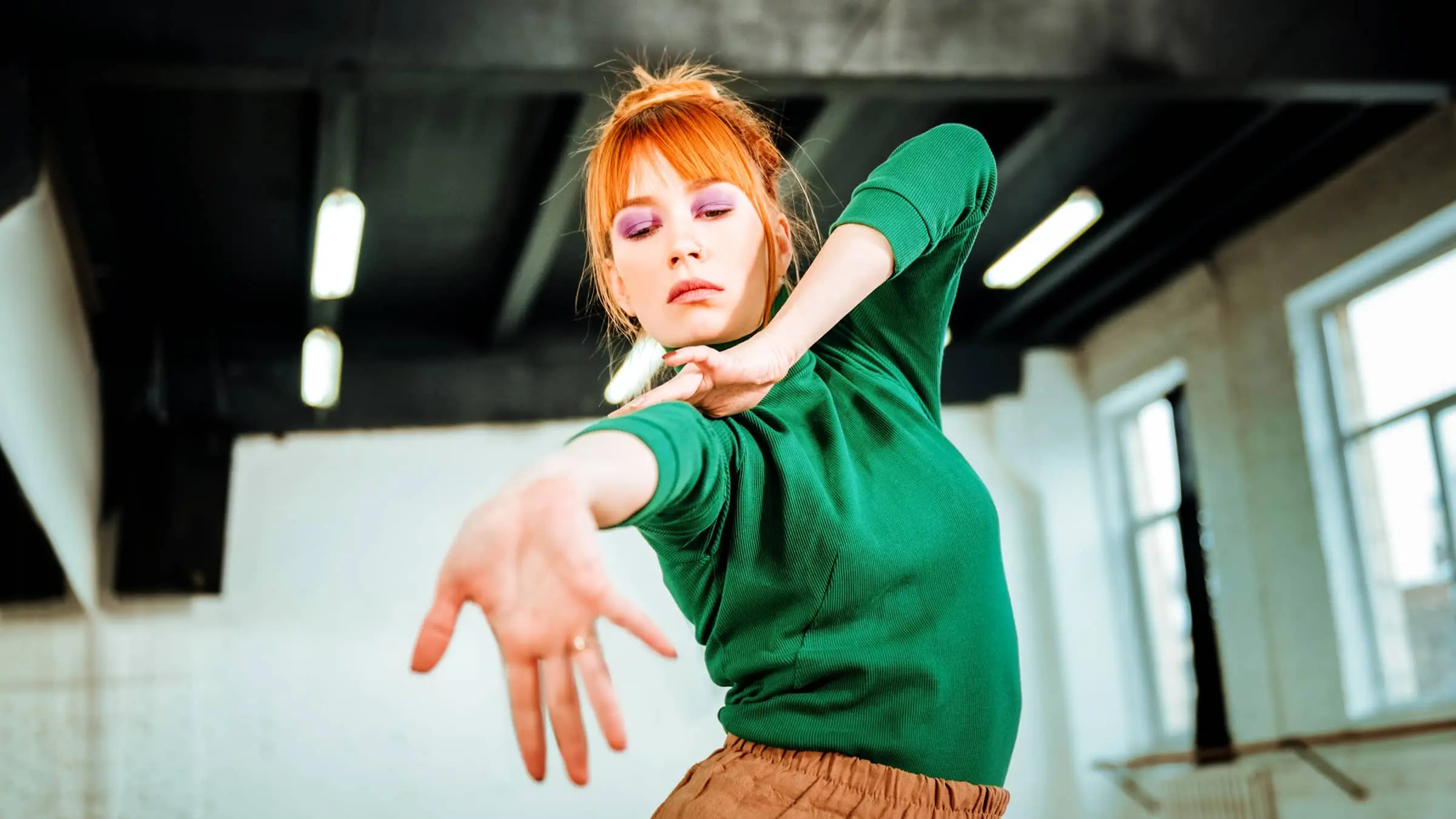
Freestyling From Home: Tips For Improvisation Growth & Discovery
by Lucia Joyce • 7:00 mins read
Start Where You Are
Maybe you’re technically and choreographically trained and want to cultivate a new freestyle practice. Maybe you already have improvisational dance training and want to keep discovering yourself. Wherever you might be on your freestyle journey, here is some guidance for those looking to flex their dance improvisation muscle, up their audition game, and spark some creative joy.
Improvisation vs. Freestyle
We know that, unlike choreography, improv dance is made up on the spot. Many artists have utilized the improvisational form: jazz musicians like Miles Davis, rappers like Notorious B.I.G. or Eminem, comedic actor/writers like Amy Poehler and Tina Fey… the list goes on. DJ’s, guitarists, bboys/bgirls, painters, and poets all typically use a hybrid system of predetermined work and whatever next thing strikes them in the moment.
Get out of your comfort zone and vibe with the world around you.
Interviewing Jeremiah ‘Supaman’ Haynes helped me to understand that the term “freestyle”, specifically in dance, has a slightly different meaning from general improvisation, because it implies ‘freedom within a specific dance style’, a style that has a history and a vocabulary, like Popping, Litefeet, or House.
Improv has a wider scope, and is not necessarily bound to just one style or vocabulary, but it still benefits from structure, and parameters, the same way a jazz tune needs an agreed-upon timing and musical key before it can get to the experimental parts.
Both improv and freestyle can be a more internalized journey or a performative one—the former is used more for choreography and creative growth, the latter is used mainly to impress someone outside of you (“to push your energy outward, rather than in” says Supaman). Both are incredible skills to have, and it helps to know which way you are focused: inward or outward, when you’re practicing.
Your Mental State On Improv
When you improvise, you unlock your brain’s creative center, and practice shutting off your inner critic. In the beginning, this may feel difficult, but everyone, with some dedicated practice, can learn to quiet their unhelpful inner judgment, and benefit wildly from creative play. It often takes starting out slowly, noticing the ‘voice of reason’ that’s putting a damper on your creative process, and gently letting that voice fade to the background. A good way to practice this is to just keep going. Don’t stop and analyze. Don’t give up on your improv session because you didn’t like how it turned out. Create a safe, judgment free mental zone and don’t quit for at least 20 minutes. Find friends/peers who support that judgment free zone and schedule a regular freestyle session together… with as little analysis as possible to start. Get out of your comfort zone and don't be afraid to get weird. The result will be a creatively stimulated brain and better alignment with the true you, not the person you’re always trying to be to fit someone else’s standards.
Both improv and freestyle can be a more internalized journey or a performative one
Adding Parameters
You are never simply creating a masterpiece on a blank canvas without structure. Your dance improv (especially when you’re first starting out) needs structure, or parameters to start flowing. Below are some parameters you might use to get out of analysis mode and into creative exploration. It is, by no means, an exhaustive list. It is a jumping off point from which to find your own means of exploration.
1. The easiest way to add parameters to your improvisation is Music. Throw a playlist on and challenge yourself to find a flow that fits the mood of each song. Give yourself a variety of genres, rhythms, and emotions to work with.
2. Another way to add structure is to give yourself Movement Constraints. Can you improvise for a full minute with your hands on the floor? Can you initiate everything with your right elbow? Your left hip? The back of your neck? Can you experiment with being as tall/wide as possible? As small as possible? See if you can reverse/retrograde from the last move you did. Open up to some fresh dynamics and transitions. Try adding more than one movement parameter at a time.
3. Along the topic of movement constraints: Try Adding Props. What movement can you explore in a chair, on a couch, or stuck to a wall? Try improvising with a (non breakable) prop like a medicine ball or hula hoop. Throw on a big jacket, a dress, a hat, or some different shoes and see how that affects your process.
4. Another important structural tool is Story Constraint. How do you move when you’re jealous? When you’re celebrating a win? Navigating a break up? Politely excusing yourself from a tense room? How do you move when you imagine your mom or your significant other is the only person in the audience? What comes up for you when you give yourself different objectives: to soothe, to rile up, to explode, to walk away? Use the lyrics in the song. Use a character arc you saw on TV. Use a conversation you wanted to have but never did. Let your imagination go there—use of story will transform predictable steps and sequences into something more emotionally grounded and interesting.
5. Train in Freestyle Dance Vocabularies Out of Your Wheelhouse. Freestyle pros take class, research OG’s, and train in a variety of established dance styles, which they can then fuse with other styles and parameters to create something fresh. New dance genres provide inspiration when you’re feeling ‘boxed in’ by one dedicated technique. If you started in jazz, ballet, modern, tap, or theatre dance, you will naturally see your body/mind’s evolution as you combine styles and let new dance training inform the old. It's a bit of a trope now, but movies love to show the crossing of dance genres as badass creative expansion (Center Stage, Save The Last Dance, Street Dance, and Step Up, to name a few). Do yourself, and your dance career, a favor by learning the specifics of a new dance genre, like the 80’s rhythmic Chicago-born House, for example, or the funky, comic dynamic of Don Campbell’s Locking, or the Los Angeles LGBT-community-born Waack/Punk movement from the 70’s that is as popular as ever today. As a bonus, getting involved in these brave, freestyle communities is a way to pay homage to the original creators and participate directly in the evolution of dance.
6. Use A Piece of Choreography as your structure. Take a combination you know from memory and play with extracting/repeating certain moves, reversing things, slowing or speeding up, changing themes/songs. See how your own work, and interpretations of others' work can be transformed by the improvisation process.
7. Find More Abstract Inspirations. It’s common in Cirque Du Soleil dance auditions to be asked to improvise around a single word or phrase, to a song you might have never heard. Don’t be afraid to get weird with it. What does it look like when you become a blade of grass, impersonate your uncle, think about the smell of bread baking, or embody a chapter of the last book you read? The sky’s the limit and when you’re more willing to go abstract, you’re more likely to stumble on unique, playful paths of discovery.
You are never simply creating a masterpiece on a blank canvas without structure.
Last Thought
Practicing in a controlled, predictable environment all the time can only take you so far: the fastest creative growth comes when you can learn from and be seen by other improvisers. There is a "different vibration" when you have others holding you accountable. Before the importance of social distancing mandates, this was most commonly found in a dance cypher: a big freestyle circle where people vibe off each other and take turns in the center. These days the cypher vibe can easily be cultivated from home in a Facetime session or Zoom meeting with fellow artists, or on live social media platforms like Instagram Live (Jeremiah recently told me he went live with a fellow freestyler and they took song/parameter requests from viewers). Once you've explored the basics of improvisation a bit, you can make your comfortable corner less predictable and volunteer to be seen. That's where the growth happens. That's where the inspiration of the community around you really flourishes. Get out of your comfort zone and vibe with the world around you, whether it’s a kick ball change in the grocery aisle or a video session with friends you can depend on for positive feedback. You can foster unique connections with friends from all over, endlessly discover something new, and deepen your commitment to your art: all essential goals in these times of isolation.
Happy Improvising!
Other Articles

How Dance Teachers Can Use Online Classes for Class Inspiration
DancePlug IncHow teachers and studio owners can use online dance classes to stay inspired, plan lessons, and support their own training.
Beginner vs. Basic Dance Classes: Which Level Should You Choose?
DancePlug IncA clear guide to choosing between basic and beginner dance classes on DancePlug.

Lucia Joyce is a bicoastal dancer, actor and writer with 15 years experience in theatre, concert, and commercial dance. Lucia started out in the Canadian contemporary scene with Josh Beamish's MOVE: the company and the 605 Collective, before moving on to New York and Los Angeles. Favorite credits include: Sweet Charity choreographed by Kathleen Marshall, 42nd Street National Tour, commercials for Heineken/H&R Block, and iLuminate's full length off Broadway work: Artist of Light. Lucia is a new member and dance captain for the women-run theatre company: Beating of Wings, and can be seen in James Chiao's production of Tenor By Night this spring. Daily blog at luciajoyce.net/blog